Books

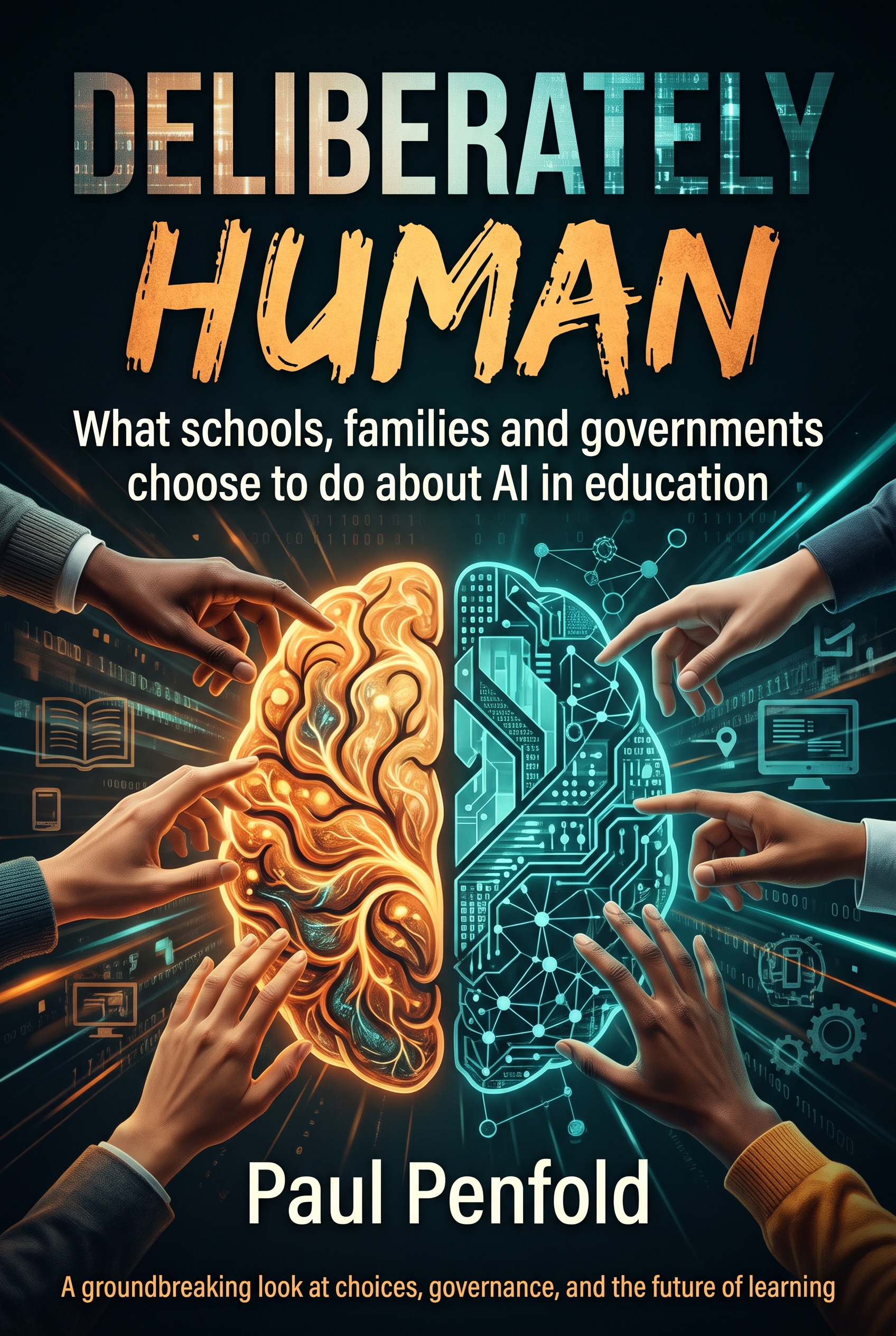
Deliberately Human

What schools, families and governments choose to do about AI in education.

Deliberately Human – book cover

First edition · October 2026 · By Paul Penfold

"Should we allow AI?" is the wrong question. This book draws together eleven research papers on assessment, teachers, wellbeing, equity, governance and school leadership, and sets out the choices now open to schools, families and governments.

It is written to be used rather than admired: each part ends with something you can try, and the book comes with interactive tools you can work through with a staff team, a class or at the kitchen table.

Free to read and share, not to adapt or sell (CC BY-NC-ND 4.0).

Coming next

The Deliberately Human series continues

Book 1 asks what we choose to do about AI in education. Books 2 and 3 take that into the classroom, and then onto the road.

Deliberately Human: Learning, Teaching and Assessment with AI – cover

Book 2 · Coming spring 2027

Deliberately Human: Learning, Teaching and Assessment with AI

AI is already in the classroom. The question now is what we check, what we trust, and what we keep deliberately human.

Eight parts, eight research papers, and practical toolkits for teachers and lecturers. Failures included.

Coming spring 2027

Deliberately Human: Listening Along the Silk Road – cover

Book 3 · Coming 2027

Deliberately Human: Listening Along the Silk Road

AI is in the classroom. But what do the people who work in classrooms actually make of it?

Paul takes the long way from Chiang Mai to London, mostly by rail, and asks educators, school leaders, lecturers and students what they check, what they trust and what they keep deliberately human. Real conversations, real campuses, and the plans that didn't survive the trip.

Follow the trip – get in touch

Coming 2027

Cover images are temporary designs and will be replaced with the final covers. Book 1 is free to read online now.

What is inside

  • A foreword and an introduction
  • Eleven parts, each following one research paper
  • Back matter with the sources and the method
  • Interactive tools: Four Futures, the Tree and the Verification Lab
  • A coach for each part, to think it through with

The course that follows the book

Fifty-two short modules take the book part by part, with a path for teachers, lecturers, department heads, school leaders, policy makers and parents. Free and self-paced.

See the course

The research behind the book

The eleven papers are open access, and the wider body of work – 37 publications, an h-index of 8 and 284 citations – is listed in full.